

By: Carlos Sanchez, COTRADO ALAC Regional Coordinator
Two Meetings, One Strategy
These are two separate meetings, held two months apart and in two different countries. However, they are part of the same strategic approach: COTRADO ALAC is deliberately building bridges with the formal trade union movement at a time when the political context in Latin America is moving in a direction that threatens workers who already lack the most basic protections.
The meeting with the Trade Union Confederation of the Americas (CSA) in Montevideo in November 2025, and the visit to the Central Única dos Trabalhadores (CUT) in São Paulo in February 2026, are not coincidental. They reflect a clear diagnosis: home-based workers and workers in the popular economy cannot fight alone for recognition and rights in a region where the political climate is becoming increasingly hostile to labor protections.
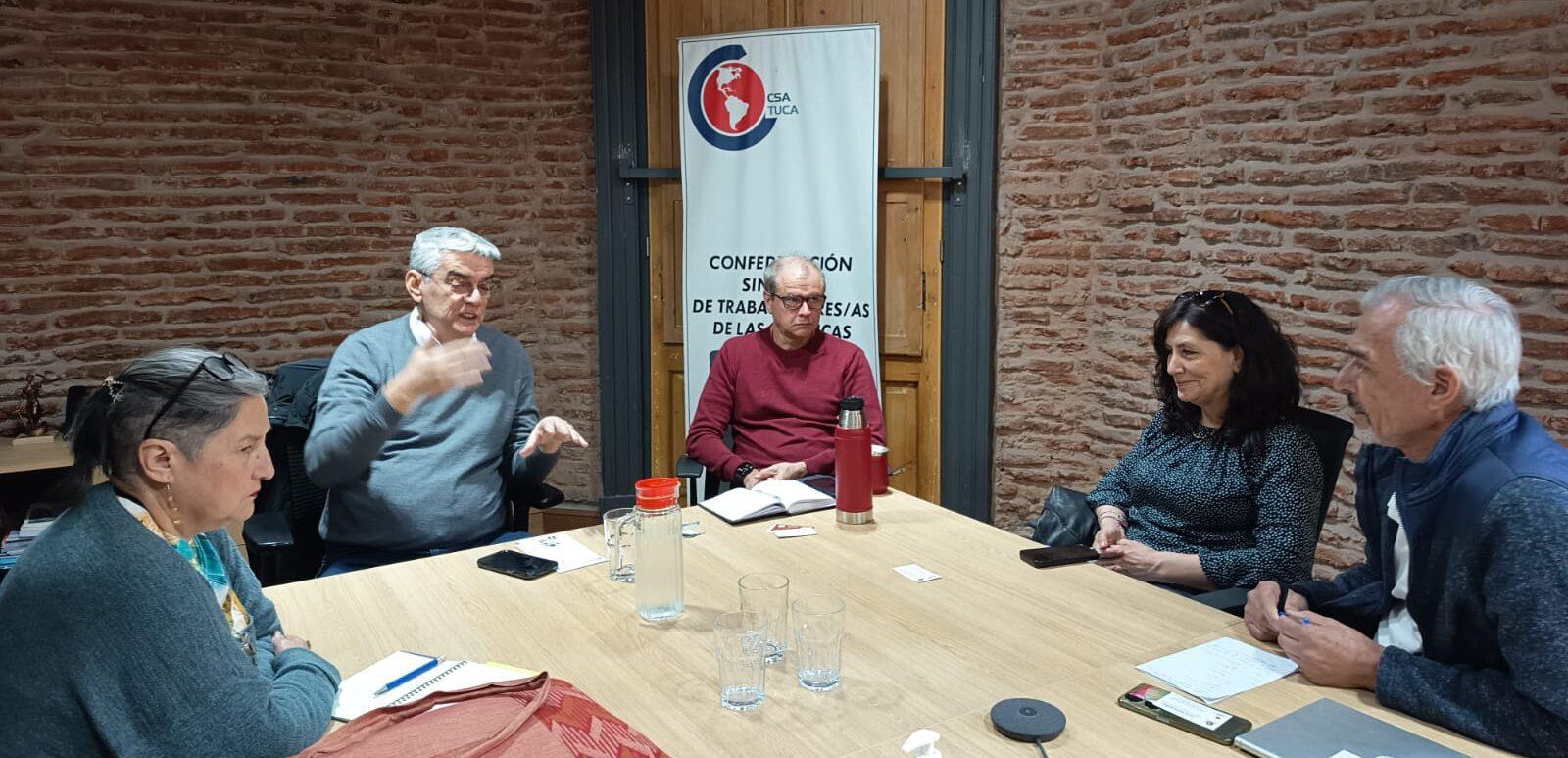
Montevideo, November 2025: Opening Dialogue with CSA
CSA—the regional organization of the International Trade Union Confederation (ITUC) for the Americas—is the largest organization within the formal trade union movement in Latin America and the Caribbean. It represents tens of millions of workers through its affiliated national confederations. Until recently, informal workers and home-based workers were largely absent from its agenda.
The meeting in Montevideo, with the CSA Secretariat, opened a direct dialogue around a question that COTRADO ALAC has been raising for years: how can the formal trade union movement expand its engagement and advocacy toward people working outside formal employment relationships? Home-based workers—most of whom are women—are precisely those most excluded from trade union structures, most invisible in labor statistics, and most vulnerable to the political changes currently affecting the region.
The conversation with CSA explored concrete forms of collaboration: joint advocacy before the ILO, the development of common views on informal economy legislation, support for the ratification of ILO Convention 177, and the inclusion of home-based workers in CSA’s regional campaigns. No formal agreement was signed at that meeting; however, dialogue was opened and a commitment was made to continue it.
The formal trade union movement cannot claim to represent workers in the region if it ignores the 50% who work outside formal employment. COTRADO ALAC is calling for a seat at the table—not as a guest, but as a partner with its own organizations, its own analysis, and its own political agenda.
São Paulo, February 2026: A Formal Visit with Strategic Significance
The visit to CUT in São Paulo on February 4, 2026, was organized as a formal meeting, but its political significance went far beyond formalities. CUT is the largest and most internationally connected trade union confederation in Brazil, with close ties to the Workers’ Party (PT) and to the global trade union movement through the ITUC.

The COTRADO ALAC delegation included Tatiana Rojas (CONATRADO Chile), Edileuza Guimarães (ATEMDO Brazil—an organization member of COTRADO ALAC in the country), and COTRADO ALAC Coordinator Carlos Sánchez. At CUT, they met with representatives from the Secretariats of International Relations, Human Rights, LGBTQIA+, and Social and Solidarity Economy.
The meeting enabled COTRADO ALAC to directly talk about the situation of women home-based workers in the region to one of the most influential labor organizations in Latin America, including the realities faced by ATEMDO’s grassroots members in Brazil, who organize textile and artisan women home-based workers outside the reach of any formal trade union structure. CUT representatives expressed interest in exploring joint actions, particularly regarding social protection for workers in the popular economy.
| Participants — CUT Brazil | Participants — COTRADO ALAC |
|
Alexandre and Luiza — International Relations Secretariat
Leandra Perpetuo — Human Rights Secretariat
Walmir Siqueira — LGBTQIA+ Secretariat
Alex Capuano — Social and Solidarity Economy Secretariat
|
Carlos Sánchez — Coordinator
Tatiana Rojas — CONATRADO Chile
Edileuza Guimarães — ATEMDO Brazil
|
Why Now? The Adverse Context Making These Alliances Urgent
These meetings are taking place in a context of growing political adversity for labor rights across the region. Women home-based workers, who are already among the least protected, have the most to lose.
| Data | Context |
| 43% | Labor informality rate in Argentina, the highest level since 2008. The February 2026 labor reform (Law 27,802) reduces dismissal costs and weakens collective bargaining, which historically pushes more workers into informality. |
| 74% | Informality in Peru, where RENATTA—a member organization of COTRADO ALAC—organizes women home-based workers without any legal framework to protect them and with no political debate in sight. |
| +80% | Informality in Nicaragua and Guatemala, where home-based textile and handicraft work is one of the few sources of income available to women, in a context of increasing restrictions on civic space. |
| 0 | Central American countries that have ratified ILO Convention 177, despite the region having the highest informality rates in Latin America. There is currently no ratification process underway in any country. (In the region, only two countries have ratified C177: Antigua and Barbuda in 2021, and Argentina in 2006). |
The regional pattern is clear: in countries with more established labor systems, reforms are moving toward deregulation, which historically expands informality; and in countries where informality is already structural, there are no significant advances toward recognition and protection of women home-based workers.
It is precisely in this context that the alliances COTRADO ALAC is building with CSA and CUT take on their full meaning. The formal trade union movement has political access, institutional presence, and resources that organizations of informal women workers lack. At the same time, these organizations represent the most invisible and vulnerable segment of the labor force and bring a specific agenda grounded in their lived reality. Neither can achieve alone what they could accomplish together.
| Adverse Regional Context | COTRADO ALAC’s Response |
|
|
The Road Ahead: From Dialogue to Joint Action
Both meetings—with CSA and CUT—are starting points, not conclusions. The next steps identified by COTRADO ALAC to translate these dialogues into concrete advocacy include:
- Formalizing the relationship with CSA through a cooperation framework to promote joint advocacy before the ILO on C177 ratification and protection of the informal economy.
- Working with ATEMDO and CUT to develop a joint position on social protection for women home-based workers in Brazil, to be presented in ongoing national tripartite consultations.
- Leveraging CSA’s access to national labor confederations in El Salvador, Nicaragua, and Peru to open participation spaces for SITRABORDO, SITRAOVDISE, and RENATTA in national dialogue processes.
- Coordinating regional messaging with CSA around ILO Convention 177, positioning it as a central labor rights issue for the entire trade union movement.
- Reporting to HomeNet International on both dialogue processes as part of the global C177 ratification campaign.
The formal trade union movement in Latin America is not a monolithic bloc, and its relationship with informal economy workers has historically been complex—marked by indifference, paternalism, or even competition. COTRADO ALAC approaches CSA and CUT not with illusions, but with a clear political argument: in a region where 50% of workers are informal, no labor movement that ignores half of the working class can claim to represent it.
That argument is gaining ground. The fact that both meetings took place and sparked interest in continuing the dialogue suggests that the formal trade union movement in the region is beginning to recognize that the future of labor rights in Latin America will, to a large extent, be shaped in the informal economy.