

By Edwin Bett; HomeNet Africa
Problem: Home-based workers constitute an important but largely unmeasured segment of Kenya’s workforce. They form part of the country’s predominantly informal economy, which accounted for approximately 84% of recorded employment in 2025. Unlike general informal employment statistics, however, Kenya currently lacks comprehensive official data disaggregating workers according to whether their economic activities are conducted from home. They contribute to national production, trade, value chains, and household livelihoods. However, they lack legal recognition as workers, denying them access to labour protections, social security, and digital social protection. Home-based workers are disadvantaged by irregular incomes, lack of written contracts, limited access to contributory social security schemes, inadequate occupational safety and health protections, and the absence of legal recognition as workers in many policy frameworks.
Solution: To secure decent work for home-based workers, HomeNet Kenya is campaigning for the government to ratify the International Labour Organization (ILO) Convention No. 177 on Home Work and adoption of the African Union Protocol on Social Protection and Social Security, which provides all workers with legal recognition, social protections, and workers’ rights.
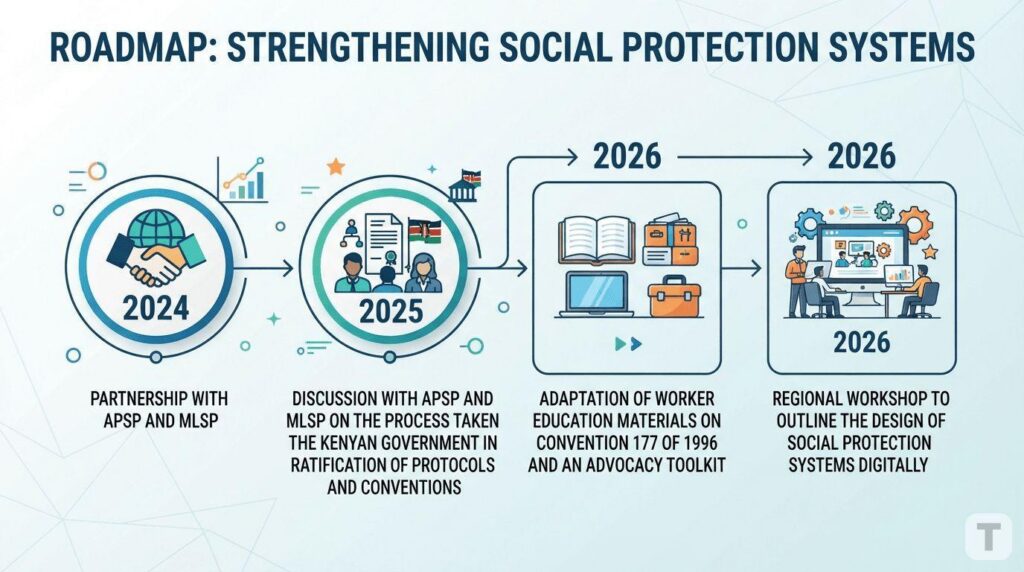
Progress Made: Over the past two years, HomeNet has built partnerships with the African Platform for Social Protection (APSP) and the Kenyan Ministry of Labour and Social Protection and has made significant strides in strengthening advocacy, worker education, digital resource development, to securing these needed reforms.
Partnership with Kenya’s Ministry of Labour and Social Protection: In November 2025, 37 home-based workers met with Ministry representatives to discuss progress towards ratifying ILO Convention No. 177. The session explained the constitutional and legal procedures required for Kenya to ratify international labour conventions while reaffirming the government’s recognition of the need to extend labour protections to workers in the informal economy and desire to continue consultation and structured dialogue between government institutions and workers’ organizations.
Our partnership with the African Platform for Social Protection has created opportunities for coordinated advocacy, policy dialogue, research, capacity building, and stakeholder engagement to advance national and regional social protection frameworks. A key area of collaboration has been shared advocacy for the Protocol on Social Protection and Social Security. It calls upon African Union Member States to guarantee universal access to comprehensive social protection throughout the life cycle, ensuring that no one is left behind regardless of their employment status, income level, gender, age, disability, or place of residence. It encourages governments to develop inclusive, rights-based policies that extend access to essential social protection, including health care, maternity protection, income security, pensions, employment injury benefits, unemployment protection, child benefits, disability support, and social assistance for vulnerable groups.
Recognizing that knowledge remains the foundation of worker empowerment and that most workers have gaps in their knowledge about their rights and entitlements to social protection, HomeNet is investing in accessible worker education materials in both print and digital formats. In January 2026, during a Fundraising and Sustainability Training Workshop in Nairobi, HomeNet Kenya completed the adaptation, printing and distribution of 150 hard copies of educational resources to workers from Rwanda, Uganda, Tanzania, Kenya, Ghana, Liberia, South Africa and Zimbabwe. The publications included a Guide to C.177 and a campaign and advocacy toolkit. These materials have been adapted from the resources section https://www.homenetinternational.org/resources/ The online repository enables organizations to download, translate, and adapt digital training materials to their contexts, thereby strengthening regional advocacy. As internet connectivity and smartphone ownership continue to expand across Africa, digital resource hubs are becoming an increasingly important avenue for worker education and movement building.
Digital inclusion and digital protections have become increasingly important issues as the government digitizes labour administration and employers platformise work. As governments increasingly digitize labour administration, social protection systems, and public services, digital inclusion has become essential for ensuring that home-based workers can fully exercise their rights. The digitalization of social protection presents home-based workers with both new opportunities and new risks. HomeNet Kenya is therefore advocating not only for legal recognition but also for inclusive digital systems.
In February 2026, HomeNet Kenya convened a regional workshop in Nairobi, supported by APSP, and with the Ministry of Labour and Social Protection in attendance. There were 16 participants from Kenya, Uganda, Tanzania, and Rwanda.
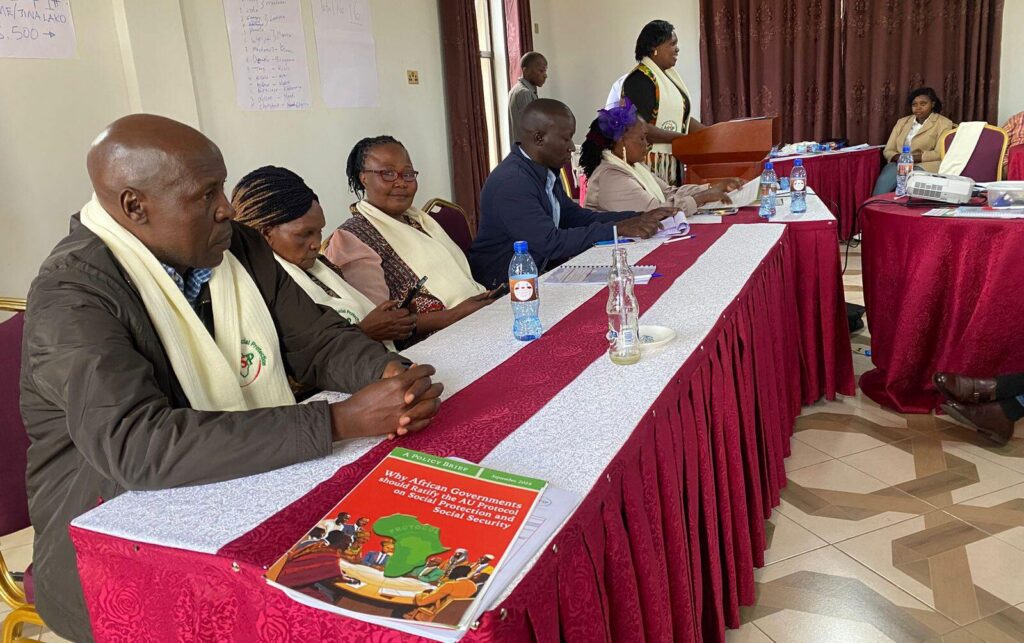
Issues covered:
- Understanding social protection concepts and terminology.
- Linking social protection, health, education, and sustainable livelihoods.
- Common misconceptions surrounding social protection.
- Designing inclusive social protection systems using a life-cycle approach.
- Lessons from Kenya and international experiences.
- Financing, benefit adequacy, coverage, and system efficiency.
- Digital literacy barriers affecting workers using basic mobile phones.
- The importance of assisted digital registration and payment support.
- Citizen participation, grievance mechanisms, and digital feedback systems.
- Data protection, privacy, and responsible data management.
Participants recognized that while digital technologies can improve efficiency, transparency, and service delivery, they must be designed to avoid excluding workers with limited connectivity, digital skills, or access to smartphones. The discussions reinforced the principle that digital transformation should complement—not replace—human support systems.
Key Lessons Emerging
Several important lessons emerged from these engagements.
- First, successful ratification of ILO Convention No. 177 requires sustained collaboration between government institutions, workers’ organizations, civil society, and international partners.
- Second, awareness of Convention No. 177 remains relatively low among many home-based workers. Continued education through both traditional and digital channels is therefore essential.
- Third, digitalization is rapidly reshaping labour markets, public service delivery, and social protection systems. Unless home-based workers are intentionally included, existing inequalities may deepen.
- Finally, strengthening labour rights requires more than policy commitments. It requires informed workers, digitally inclusive systems, strong worker organizations, accessible information, and governments willing to engage constructively with stakeholders.
Next Steps
Through sustained advocacy, worker education, strategic partnerships, digital innovation, and evidence-based dialogue, the movement for decent work and inclusive social protection continues to gain momentum—bringing Kenya closer to a situation where every home-based worker enjoys recognition, protection, dignity, and equitable access to the opportunities created by digital transformation.
To accelerate this progress, continued technical and financial support is essential. In particular, support is needed to convene multi-stakeholder dialogue forums, policy consultations, and engagement meetings with key government ministries, CSOs, academic institutions and development partners. These platforms are critical for expanding social dialogue, building consensus, strengthening coordination, and sustaining the momentum towards the ratification and effective implementation of ILO Convention No. 177. These engagements also provide opportunities to amplify the voices and lived experiences of home-based workers, ensuring that national labour and social protection policies reflect their realities and priorities.
With continued collaboration and investment, Kenya has a unique opportunity to become a regional leader in promoting decent work for home-based workers, demonstrating how inclusive policies, social dialogue, and digital innovation can transform livelihoods and contribute to sustainable and equitable economic development.