
By: Suntaree Saeng-ging, HomeNet Southeast Asia Executive Director
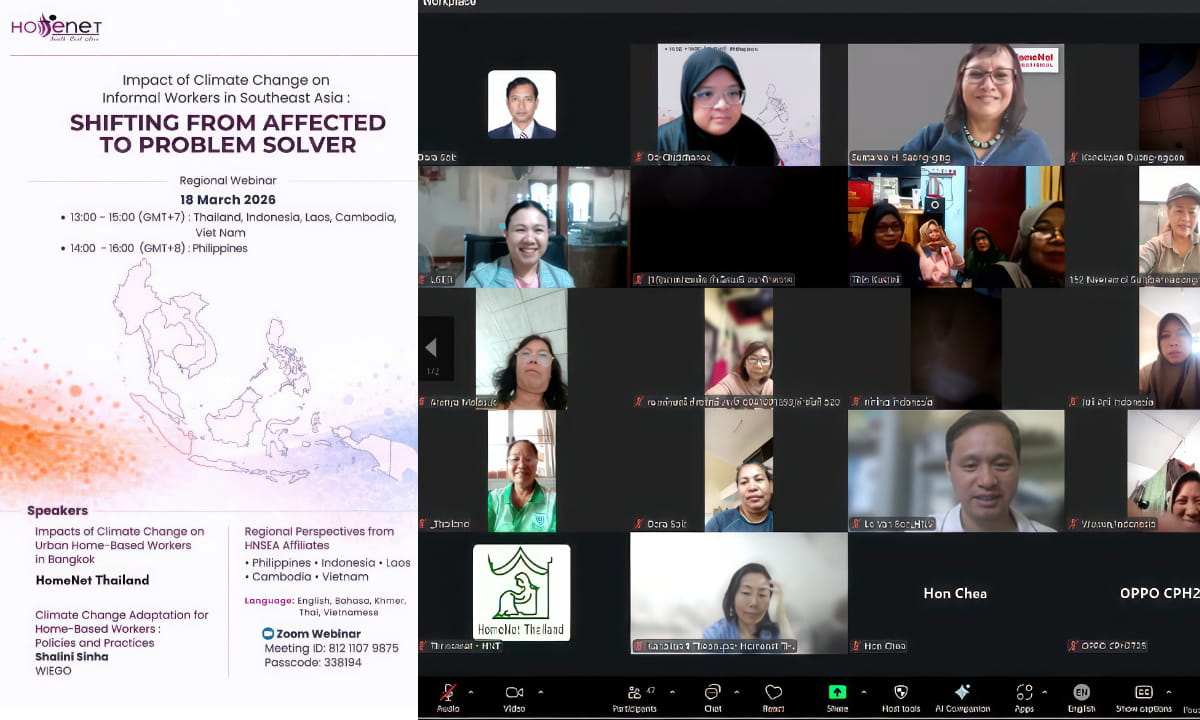
On 18 March 2026, from 1 to 3 p.m. ICT, HNSEA organized the regional webinar “Impact of Climate Change on Informal Workers in Southeast Asia: Shifting from Affected to Problem Solver.” This webinar included four sessions:
- Presentation of the study on the impacts of climate change on urban home-based workers in Bangkok by HomeNet Thailand
- Sharing the situation, adaptation experiences, and perspectives from HomeNet Cambodia, HomeNet Indonesia, HomeNet Lao, HomeNet Philippines, and HomeNet Vietnam
- Guest speaker Shalini Sinha from WIEGO on “Climate Change Adaptation for Home-Based Workers: Policies and Practices”
- The way forward
The webinar had 62 participants, all members of the HNSEA Executive Committee, including HNSEA members, representatives from allied organizations, and academic professionals.
During the webinar, it was confirmed that climate change has made the lives and livelihoods of home-based workers harder, compounding existing challenges such as unrecognized status, lack of labor law protection, and insufficient social security schemes. Women home-based workers, who are also unpaid care workers, reported that their care burdens have increased due to the effects of climate change.
It was also noted that existing climate change policies and plans in Southeast Asian countries largely exclude informal workers and lack a workers’ rights and women’s rights perspective.
Looking forward, HNSEA recognizes that alongside adaptations within our movement, such as implementing savings and loan programs for adaptation support, there is a need for strong advocacy to influence existing climate change policies and fill these gaps at both national and local levels across the six member countries. This includes expanding the benefits of social security schemes to address climate change-related issues.