

By: Carlos Sánchez, COTRADO ALAC Regional Coordinator
At the end of August, in the district of Comas, north of Lima, a grassroots group of women members of COTRADO ALAC enrolled in garment-finishing courses. This enrollment is not a minor training detail: it is a commitment to competing once again in a market suffocated by cheap imports and threatened by insecurity. Behind every children’s pajama and every piece of textile work lies a story of starting over, disability and struggle.
Women in Comas are currently making children’s pajamas. Their enrolment in garment-finishing courses is due to a simple but harsh reality: a demanding market only makes room for those who deliver quality products. One of the women, an older worker, knows that her products must be properly finished if she is to compete with imported goods. For her, the course is not an ornament; it is the difference between selling and not selling, between maintaining her trade and abandoning it.
Another woman is already selling the textiles she makes with materials provided by the organization to help her start over. She used to sew sheets, but imports are sold so cheaply that her production was pushed out of the market. She is deaf, and her disability does not open doors for her in the formal labor market. Her economic livelihood therefore depends on the work she does at home: textiles, finishing work, and small, regular deliveries. Her experience confirms a regional reality: own-account home-based work is, for thousands of women with disabilities or without access to formal employment, their only source of income.
The political and social situation forces our sisters to remain “in a constant state of alarm” in the face of municipal inspectors: if they catch you, they take your products. But the problem does not end with inspections. Hitmen have reached street vendors and women home-based workers. They cannot carry large quantities of goods for delivery: they see you, take your goods, follow you home and threaten you to make you pay. The organization ceases to be merely a training space and also becomes a network of mutual protection.
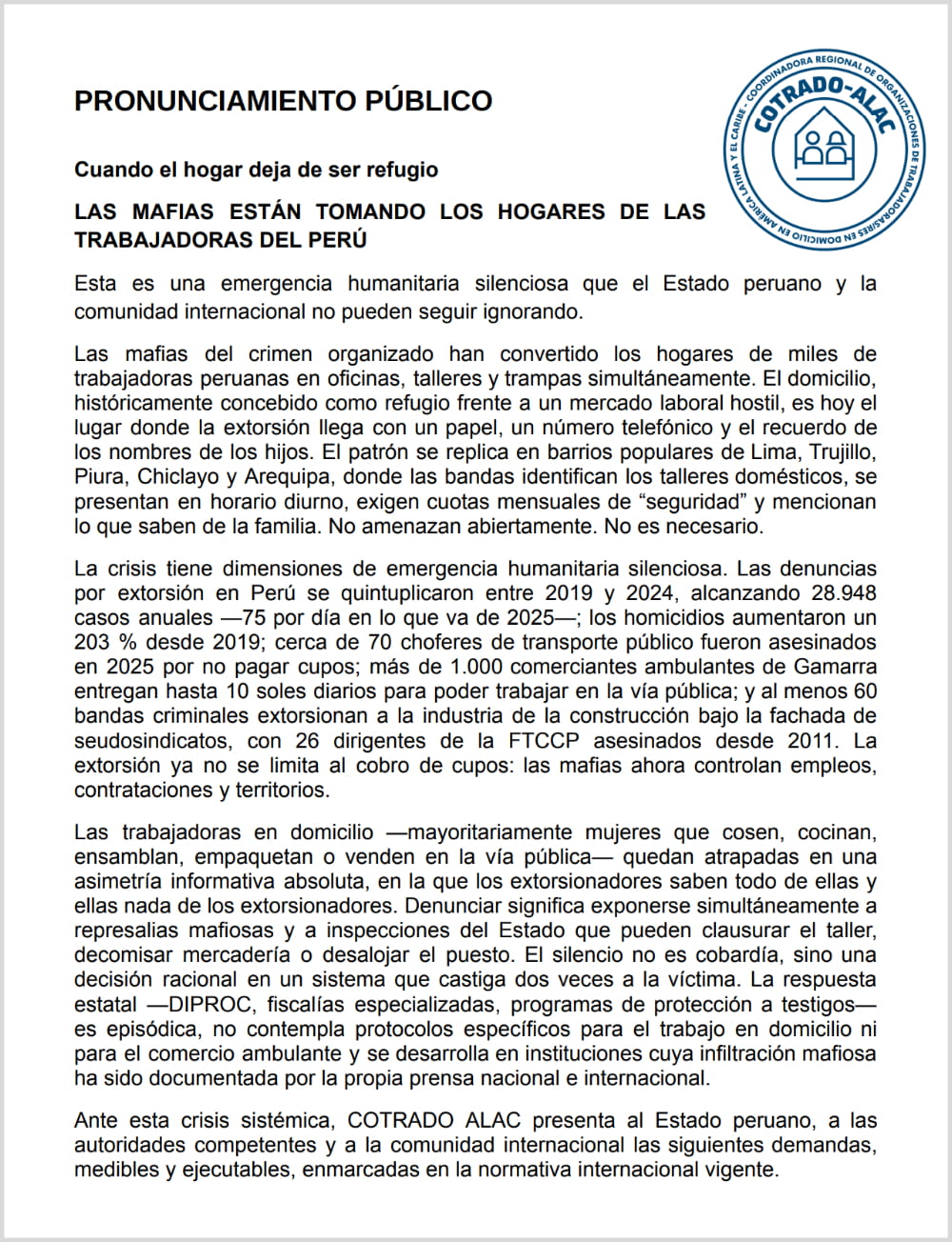
These experiences are the concrete reality behind what COTRADO ALAC’s public statement denounces. Without the ratification and effective implementation of ILO Convention 177 on Home Work, without compliance with Convention 190 on Violence and Harassment in the World of Work, and without a critical review of Recommendation 204 on the Transition from the Informal to the Formal Economy, these women workers are vulnerable to exploitation in the informal labor market and to abandonment by the State.
Behind every garment lies the political decision to sustain a trade in a country that still does not fully recognize women home-based workers. The experience of Comas proves that COTRADO ALAC’s statement is not rhetoric, but the translation of a concrete and urgent reality.
Please see COTRADO ALAC’s public statement